
A biopsy recommendation can feel alarming, even when the word “biopsy” covers a wide range of procedures from minor to major.
For patients who have received a TR4 or TR5 TIRADS score on their ultrasound report, the recommendation for an FNA thyroid nodule biopsy arrives alongside a natural wave of anxiety. The words “needle” and “biopsy” tend to do that.
This article explains exactly what an FNA thyroid nodule biopsy involves, when it is recommended, what the Bethesda classification system means, and what to expect from the appointment itself. Understanding the process before the appointment is the most effective way to arrive prepared rather than anxious.
What Is an FNA Thyroid Nodule Biopsy?
FNA, or fine-needle aspiration, is a minimally invasive diagnostic procedure in which a fine needle is guided into a thyroid nodule to collect a small sample of cells for laboratory analysis. It is the gold standard for determining whether a thyroid nodule is benign or malignant, and it is not surgery.
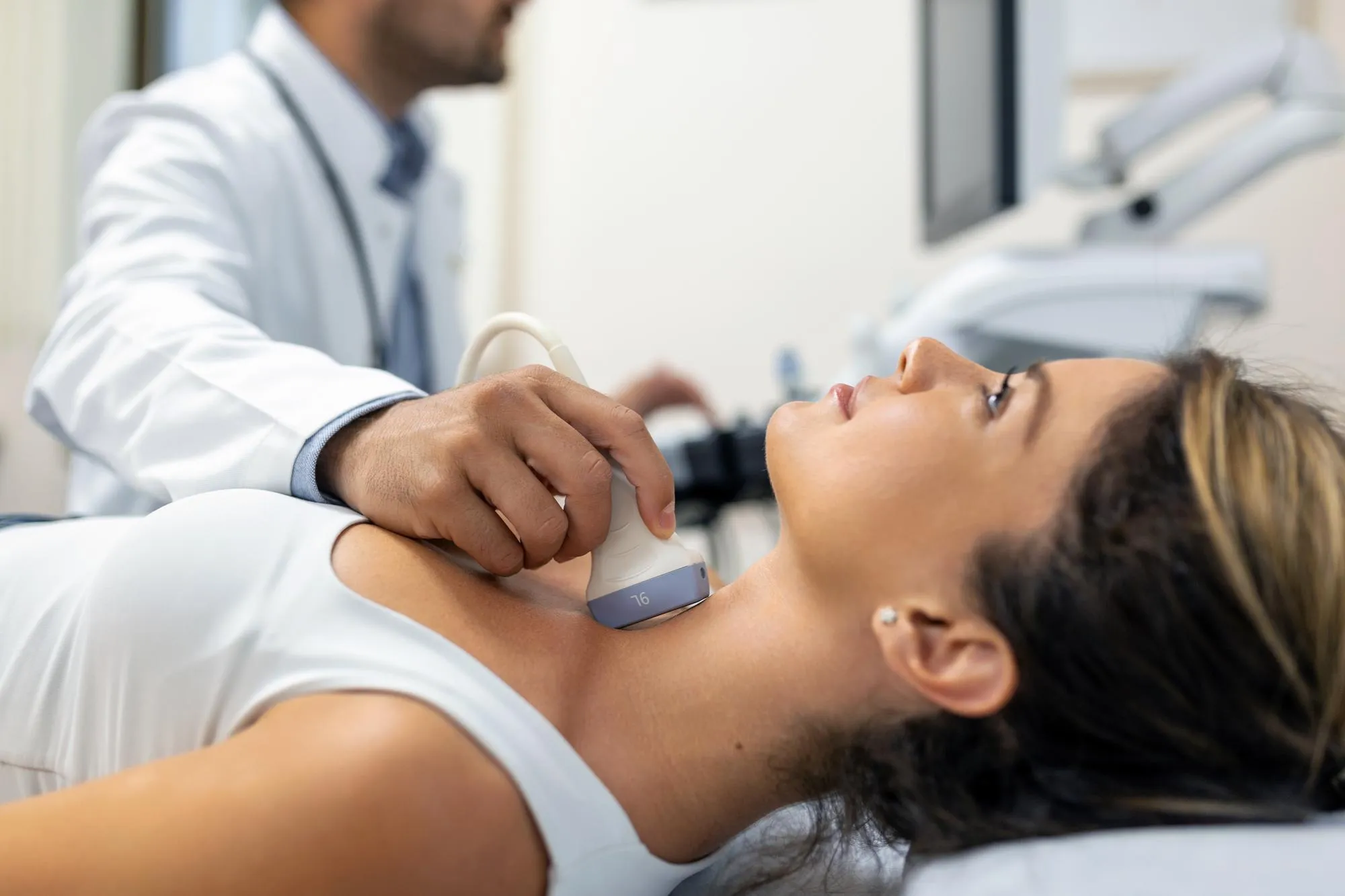
The procedure is often performed under ultrasound guidance to ensure the needle reaches the correct position within the nodule. The cells collected are sent to a pathologist, who analyses them under a microscope and returns a Bethesda classification that guides all subsequent management decisions.
FNA is an outpatient procedure. There is no overnight stay, no general anaesthesia, and no recovery ward. Most patients return to normal activities the same day.
When Is FNA Recommended?
FNA biopsy is recommended based on a combination of the TIRADS score assigned on ultrasound and the size of the nodule. The standard thresholds are TR4 nodules over 1.5cm and TR5 nodules over 1cm. Not all nodules require biopsy, and TR1 and TR2 nodules are monitored without it.
Beyond size and score, FNA is also recommended for nodules that have grown more than 20 per cent on surveillance imaging, nodules causing compressive symptoms such as difficulty swallowing or voice changes, and any nodule where a prior FNA returned a Bethesda III or IV result requiring clarification.
A TIRADS score of TR3, TR4, or TR5 does not automatically mean biopsy is required; the size threshold must also be met. An ENT specialist reviews the full clinical picture to determine whether FNA is the appropriate next step.
Step-by-Step: What to Expect at Your FNA Appointment

The FNA appointment moves through three phases: preparation before the procedure begins, the procedure itself, and a short recovery before the patient leaves. Most patients describe the overall experience as considerably less daunting than their anticipation of it.
Allow approximately 45 minutes to one hour in total if FNA is being performed on the same visit as the consultation. The ultrasound component alone takes 5 to 10 minutes, and the biopsy adds a further 10 to 15 minutes including preparation.
Results from the cell sample are typically available within 3 to 5 working days, and a follow-up appointment is scheduled to review the findings and explain the Bethesda category in full.
Before the Procedure
No fasting is required before an FNA biopsy, and no special preparation is needed. Patients who take blood thinners, including aspirin, warfarin, or newer anticoagulants, should inform the surgeon in advance, as these may need to be paused.
The patient lies on a couch with the neck extended slightly to give the surgeon clear ultrasound access to the thyroid. Ultrasound gel is applied to the skin. There is no theatre booking, no stitches, and no hospital admission involved.
During the Procedure
The surgeon locates the nodule using the ultrasound probe and confirms its position.
A fine needle, comparable in gauge to the needle used for a standard blood test, is guided into the nodule under direct ultrasound visualisation. Cells are aspirated through the needle as it is gently moved within the nodule. The needle is then withdrawn and light pressure is applied to the puncture site. The entire aspiration takes approximately 10 to 15 minutes, and the surgeon may make two or three passes to collect an adequate sample.
The aspiration itself is typically felt as mild pressure rather than sharp pain.
After the Procedure
A small plaster is applied to the puncture site once the procedure is complete. There is no wound to care for and no stitches to remove.
Minor bruising at the injection site is normal and resolves within a few days. Patients are advised to avoid strenuous exercise for 24 hours. Most patients return to work and normal activities on the same day.
Understanding Your FNA Results: The Bethesda Classification

FNA results are reported using the Bethesda System for Reporting Thyroid Cytopathology, an internationally recognised six-category classification that guides all management decisions following biopsy. Each category carries an estimated malignancy risk and a corresponding recommended action.
The Bethesda result is not a diagnosis of cancer. It is a diagnostic framework that tells the specialist how to proceed. Most FNA results fall into Category II, which is benign, and require no further surgical intervention.
Understanding the category on the report before the follow-up appointment removes the anxiety of encountering an unfamiliar classification without context.
Bethesda I: Non-Diagnostic
A Bethesda I result means insufficient cells were collected during the aspiration to make a reliable assessment. This is not a procedure failure; it occurs in a small proportion of biopsies, particularly when nodules are cystic or difficult to aspirate.
A repeat FNA is typically recommended after a minimum of three months. A Bethesda I result does not indicate malignancy.
Bethesda II: Benign
Bethesda II is the most common FNA result. It indicates a benign finding, most commonly a benign follicular nodule, thyroiditis, or a simple cyst, with an estimated malignancy risk under 3 per cent.
No surgery is required for a Bethesda II result. Standard management involves continued ultrasound surveillance at a one to two year interval to monitor for any change.
Bethesda III and IV: Indeterminate
Bethesda III (Atypia of Undetermined Significance) and Bethesda IV (Follicular Neoplasm or Suspicious for Follicular Neoplasm) are the two indeterminate categories. These results generate the most patient anxiety, because neither confirms a benign nor a malignant diagnosis.
Bethesda III carries an estimated malignancy risk of 5 to 15 per cent. Bethesda IV carries an estimated risk of 15 to 30 per cent. Options for managing indeterminate results include a repeat FNA at three months, molecular testing where available, or diagnostic hemithyroidectomy to obtain definitive histological analysis on the removed tissue. A specialist consultation is essential to determine the most appropriate approach given the individual clinical picture.
Bethesda V and VI: Suspicious or Malignant
Bethesda V (Suspicious for Malignancy) carries a high risk of malignancy, and surgical management is the standard recommendation. Bethesda VI (Malignant) indicates a malignant finding on cytology, and surgery is indicated.
Even at Bethesda VI, early-detected thyroid cancer, particularly papillary thyroid carcinoma, has among the most favourable outcomes of any malignancy. A specialist referral and full clinical discussion are the appropriate next steps.
Is FNA Biopsy Painful? Honest Answers
The most common question before an FNA appointment is whether it hurts. The honest answer is that most patients tolerate the procedure without significant discomfort, and the fear of the procedure reliably exceeds the experience of it. A similar analogy is that it entails the same level of pain as a blood taking procedure.
Some patients experience a brief, sharper sensation during the needle pass, which lasts a few seconds. The procedure is short, well-tolerated, and performed as an outpatient.
A blood test or vaccination provides a useful point of comparison. The FNA needle is of similar gauge, and the discomfort profile is broadly comparable. Patients who find blood tests easy to manage typically find FNA similarly manageable.
Conclusion About FNA Thyroid Nodule Biopsy
An FNA thyroid nodule biopsy is a short, minimally invasive procedure that provides the diagnostic clarity needed to make the right management decision. The Bethesda classification system translates the cell sample into a clear, evidence-based recommendation that removes guesswork from the process.
Dr. Soma Subramaniam offers a direct clinical pathway from FNA biopsy to Bethesda result interpretation and, where indicated, through to thyroid surgery in Singapore. His in-clinic services include ultrasound-guided FNA biopsy, full Bethesda result review and counselling, and surgical management for patients whose results indicate the need for thyroid surgery.
Contact us today to book a consultation and get a clear answer on the next steps for your thyroid nodule.
Frequently Asked Questions About FNA Thyroid Nodule
What Is an FNA Biopsy for a Thyroid Nodule?
FNA (fine-needle aspiration) biopsy is a minimally invasive procedure in which a fine needle is used to collect cells from a thyroid nodule under ultrasound guidance. The sample is sent for laboratory analysis and reported using the Bethesda classification. It is the gold standard for determining whether a nodule requires surgical removal.
Does FNA Thyroid Biopsy Hurt?
Most patients describe the sensation as similar to a blood test or mild pressure. The aspiration itself is typically felt as pressure. Most patients return to normal activities the same day.
How Long Does It Take to Get FNA Thyroid Results?
Results are typically available within 3 to 5 working days. A follow-up appointment is scheduled to discuss the Bethesda result and recommend the appropriate next step, whether that is watchful waiting, repeat biopsy, or surgical referral.
What Does an Indeterminate FNA Thyroid Result Mean?
Bethesda III or IV results are classified as indeterminate, meaning the cells collected are neither clearly benign nor clearly malignant. This does not mean cancer is present. Options include repeat FNA, molecular testing, or diagnostic hemithyroidectomy to obtain a definitive tissue diagnosis. A specialist will advise based on the clinical picture and nodule characteristics.