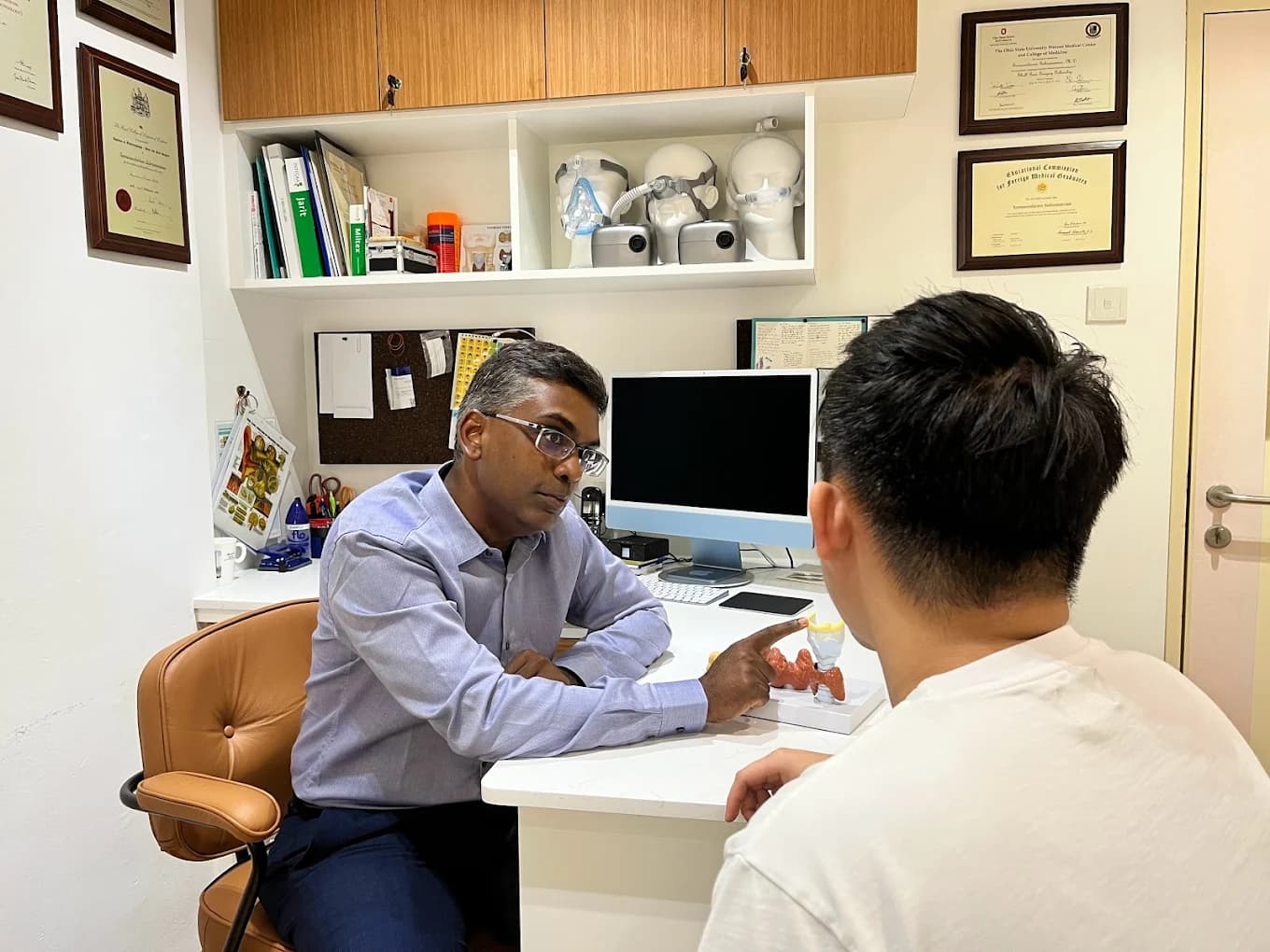
A pituitary tumour diagnosis can feel overwhelming, and it helps to speak with a specialist who can explain what it means for you. Meet Dr Soma, a Senior ENT Consultant fellowship-trained in endoscopic sinus and skull base surgery at The Ohio State University, USA, for a considered assessment of your imaging, symptoms, and options.
Care for a pituitary tumour is individualised and often shared across several specialists. Where surgery is appropriate, a minimally invasive endoscopic endonasal approach performed through the nostrils, together with a neurosurgical team, may be one of the options discussed with you.
The pituitary gland is a small, pea-sized gland at the base of the brain. It sits in a bony hollow called the sella turcica, just behind the nose and sinuses, and it helps regulate many of the hormones that keep the body in balance.
A pituitary tumour is a growth that develops in this gland. Most are benign (non-cancerous) and slow-growing, and are known as pituitary adenomas. Depending on the type and size of the tumour, it may affect hormone levels or press on nearby structures, such as the nerves that carry vision.
Depending on the type and size of the tumour, you may notice one or more of the following. Some people have no symptoms at all:

Pituitary tumours vary widely in how they behave, so understanding the type helps guide an individualised plan. The following are commonly discussed during assessment:
A common type of pituitary adenoma that does not produce excess hormones. It may still grow over time and press on nearby structures such as the optic nerves.
An adenoma that produces excess hormones. Specific types include prolactinoma, growth-hormone-secreting adenoma (associated with acromegaly), and ACTH-secreting adenoma (associated with Cushing's disease). Some, such as prolactinomas, are often managed with medication first.
A smaller tumour, generally under about 10 mm. Depending on its hormone activity and symptoms, it may be monitored or treated.
A larger tumour of about 10 mm or more, which is more likely to press on nearby structures such as the optic nerves and surrounding tissue.
Pressure on the optic nerves can reduce side vision or affect sight. This is assessed with visual-field testing and imaging, often alongside an ophthalmologist.
Over- or under-production of pituitary hormones may affect energy, metabolism, menstrual cycles, growth, and other body systems, and is reviewed together with an endocrinologist.
A pituitary tumour is managed individually, and not every tumour needs surgery. A specialist assessment helps clarify whether monitoring, medical therapy, or surgery is most appropriate for your situation. You may wish to arrange an assessment if you are:

Every pituitary tumour is different, so care is individualised and often shared across several specialists. Depending on the type and size of the tumour, the recommended path may range from monitoring or medical therapy to surgery.
The first step is a careful assessment to understand the type and size of the tumour and how it may be affecting you.
Detailed Assessment
A thorough consultation and clinical examination, with a review of your symptoms, medical history, and any previous scans.
Dedicated Imaging
A pituitary-focused MRI scan helps define the size and position of the tumour and its relationship to nearby structures such as the optic nerves.
Coordinated Endocrine, Ophthalmology (Eye) and Neurosurgery Input
Where relevant, findings are reviewed together with endocrinology for hormone assessment and ophthalmology for visual-field testing, so that planning reflects the whole picture.

When surgery is recommended, the current gold standard is a minimally invasive endoscopic endonasal transsphenoidal approach. It is performed through the nostrils and nasal passages, through the sphenoid sinus, to reach the pituitary gland, which avoids external facial and craniotomy incisions. This surgery is carried out together with a neurosurgical team.
Access Through the Nostrils
An endoscope and fine instruments are passed through the natural nasal passages, so there are no external facial incisions.
Shared Surgical Care
The nasal passage corridor is often prepared by the ENT skull base surgeon, while the tumour is addressed in coordination with a neurosurgical team. Closure of the defect is primarily performed by the ENT skull base surgeon.
Individualised Planning
Whether this approach is suitable depends on the type, size, and position of the tumour, and it is discussed with you before any decision is made.
When an endoscopic endonasal approach is suitable, it offers several practical features that are stated here as points to discuss with your specialist rather than as guaranteed outcomes:

Dr Soma is a Senior ENT Consultant fellowship-trained in endoscopic sinus and skull base surgery at The Ohio State University, USA, and brings this experience to the assessment and endonasal management of pituitary and related conditions.
Where surgery is appropriate, Dr Soma works through the natural nasal passages using an endoscope, an approach that avoids external facial incisions. Suitability depends on your individual situation.
Pituitary care is usually shared across specialists. Dr Soma coordinates with a neurosurgical team, endocrinology, and ophthalmology so that your assessment and any treatment reflect the whole picture.
Administrative support to obtain insurance approvals for surgery and admissions is provided by the clinic support team. A consultation with Dr Soma starts from about $180.
Dr Soma is fully accredited by the Singapore Ministry of Health (MOH) and the Singapore Medical Council (SMC), and practises at Paragon Medical Centre (Orchard) and Parkway East Specialist Hospital (Joo Chiat).

Recovery after pituitary surgery is followed closely and varies between individuals. The steps below are general guidance, and your own aftercare plan will be tailored to you by your surgical and endocrine team:
After endonasal pituitary surgery, patients are usually monitored in hospital so that hormone levels, fluid balance, and general recovery can be observed. Length of stay varies between individuals.
The nasal passages may feel congested for a period after surgery. Your team will give you specific instructions on gentle nasal care and what to avoid.
You may be advised to avoid heavy lifting, forceful nose blowing, and strenuous activity for a period to support healing. Please follow the guidance given to you.
Because the pituitary regulates several hormones, ongoing blood tests and endocrine review are commonly arranged, and some patients may need hormone replacement. This is assessed individually.
Follow-up may include repeat visual-field testing and imaging so that the area can be reviewed over time.
Recovery is followed with scheduled clinic visits so that progress can be checked and any concerns can be addressed.
From obtaining a Letter of Guarantee (LOG) from your insurer to securing a pre-authorisation certificate, we’ll do the necessary paperwork for you.
Shield Plans:




Corporate Plans:






A thorough specialist consultation with Dr Soma, a Senior ENT Consultant fellowship-trained in endoscopic sinus and skull base surgery at The Ohio State University, USA, to review your symptoms, medical history, and any imaging you have already had.
A coordinated diagnostic review, which may include a dedicated pituitary MRI scan, hormone (endocrine) assessment, and visual-field testing, with input from endocrinology, ophthalmology and neurosurgery where relevant.
A clear, individualised discussion of the options that may suit your situation, which can range from monitoring or medical therapy to a minimally invasive endoscopic endonasal procedure performed together with a neurosurgical team.
If you would like a specialist assessment of a pituitary tumour, Dr Soma and our team can review your imaging and symptoms and explain the options that may suit your situation. Care is individualised and often shared with a neurosurgical, endocrine, and eye-care team.
Most pituitary tumours are benign (non-cancerous) growths called adenomas, and many grow slowly. A specialist assessment, including imaging and hormone tests, helps clarify the type of tumour and what it means for you. Cancerous pituitary tumours are uncommon.
No. Care is individualised. Some small tumours that cause no symptoms may simply be monitored, and some types, such as prolactinomas, are often managed with medication first. Surgery is considered when it is felt to be the most appropriate option after a full assessment.
It is a minimally invasive approach in which the pituitary gland is reached through the nostrils, nasal passages and sphenoid sinus using an endoscope, which avoids external incisions. It is commonly performed together with a neurosurgical team.
Often, yes. Pituitary care is usually multidisciplinary and may involve an ENT skull base surgeon, a neurosurgeon, an endocrinologist (hormone specialist), and an ophthalmologist (eye specialist), so that your care reflects the whole picture.
Yes. Our team can guide you on Insurance and Integrated Shield Plan claims, Letters of Guarantee (LOG), and Medisave where applicable, and provide clear information on costs. A consultation with Dr Soma starts from about $180.

ENT PLUS Specialist Centre Singapore
MBBCh (IRE) | DOHNS (ENG) | MMED-ORL (NUS) | FRCS-ORL (ENG)
Consultant ENT Specialist and Surgeon
Your Partner in Sinus, Allergy and ENT Health
Dr Soma Subramaniam is a MOH-accredited ENT specialist with fellowship training in endoscopic sinus and skull base surgery. He is Past President of the Singapore ENT Society and Founding President of the ASEAN Rhinologic Society. Dr Soma is committed to patient care, teaching, and advancing ENT knowledge through research and training the next generation of specialists.
321 Joo Chiat Place #05-01 Parkway East Specialist Hospital
Singapore 427990
Opening Hours
Monday–Friday: 9am – 5pm
Saturday: 9am – 12.30pm
290 Orchard Road #09-20/21 Paragon Medical Centre
Singapore 238859
Opening Hours
Monday–Friday: 9am – 5pm
Saturday: 9am – 12.30pm
Phone
+65 6517 9776
+65 6320 0353
(Calls only available during clinic opening hours)
+65 9856 8391
(Messaging only for appointment-related matters, no calls)
enquiry@entplus.sg