Tinnitus, the perception of ringing, buzzing, or hissing in the ears, can be unsettling and may affect your sleep, focus, and quality of life. Because it is often a symptom of an underlying condition rather than a condition in itself, a proper assessment matters.
Meet Dr Soma, a Senior ENT Consultant fellowship-trained in endoscopic sinus and skull base surgery at The Ohio State University, USA, for a considered and unhurried evaluation of your tinnitus in Singapore. Together you can work towards understanding the possible cause and a management plan suited to your situation.
Tinnitus is the perception of sound, such as ringing, buzzing, hissing, or humming, when there is no external source present. It can affect one or both ears, and it may be constant or come and go. For some people it is a mild background noise, while for others it can be more intrusive.
Importantly, tinnitus is not usually a disease in itself. In many cases it is a symptom of an underlying condition that should be assessed by a doctor. It may be linked to hearing changes, ear wax build-up, noise exposure, ear or sinus infections, or other factors, and identifying the cause is an important first step.
People experiencing tinnitus may notice one or more of the following:

Tinnitus can arise for a range of reasons, and understanding the possible cause helps guide appropriate care. During your consultation, Dr Soma can help determine which of the following may be relevant to your situation:
The most common form, perceived only by the individual. It is often associated with hearing changes or previous noise exposure.
A less common form that may sometimes be detected during examination, and can be linked to blood vessel or muscle activity near the ear.
Ringing that may follow exposure to loud sound, whether a single loud event or repeated exposure over time.
Tinnitus can sometimes accompany the gradual changes in hearing that some people notice as they get older.
A build-up of ear wax or a blockage in the ear canal can, in some cases, contribute to tinnitus and may be reversible once addressed.
Tinnitus may be associated with middle ear problems, Meniere's disease, certain medications, or other health conditions that a specialist can help identify.
While occasional, brief ringing is common and often settles on its own, a specialist assessment can be helpful when tinnitus is persistent or affecting your daily life. You may wish to seek an evaluation if you are:
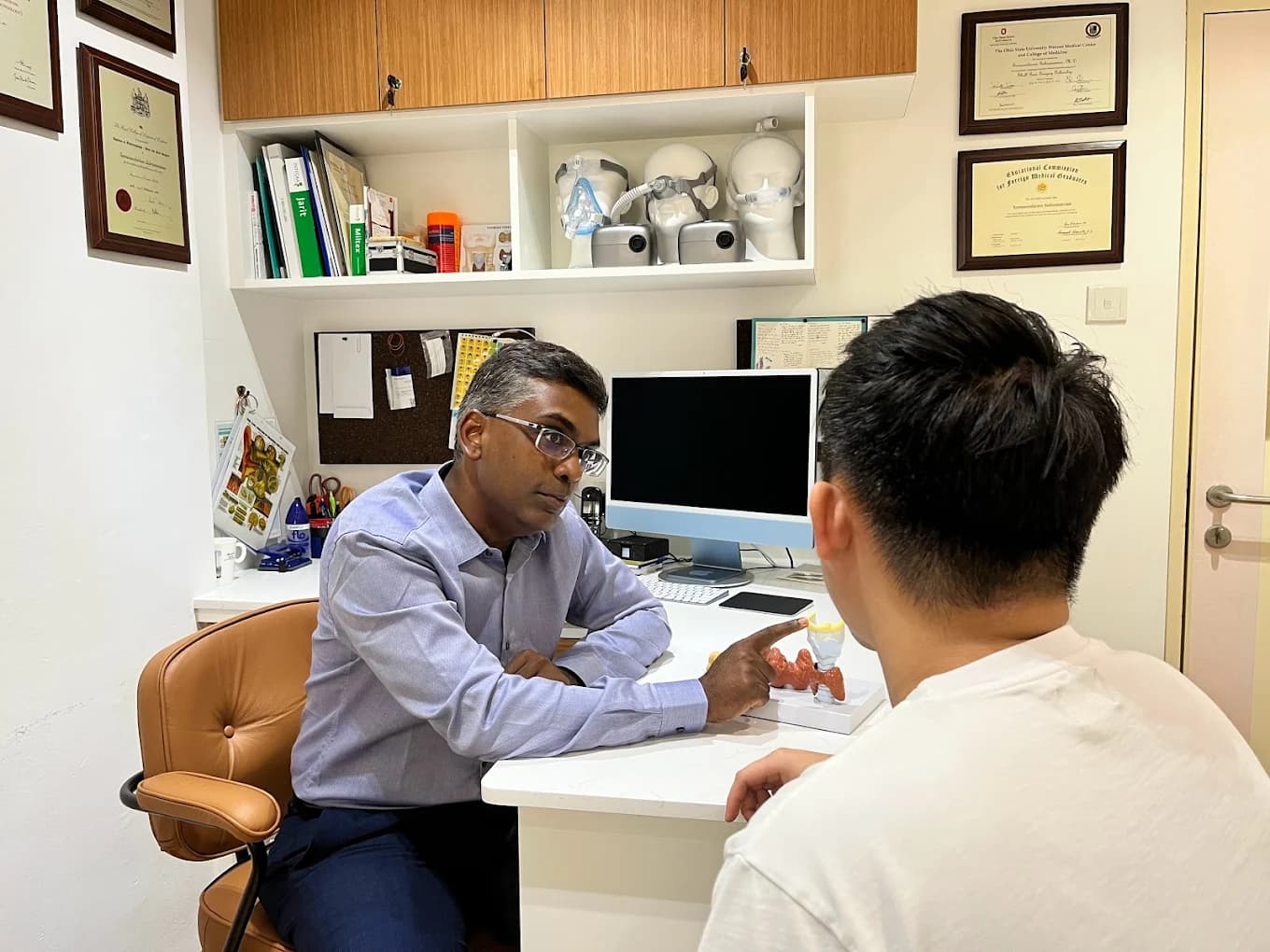
Tinnitus is usually assessed first by an ENT doctor, because most of the causes sit in the ear, the hearing pathway or the structures around them, and because the assessment needs the ear examined and the hearing measured. An ENT assessment for tinnitus covers three questions:
The consultation begins with a history: what you hear, in which ear, whether it is constant or intermittent, when it started, what your noise exposure has been, and what medications you take. This is followed by examination of the ears, and where relevant the nose and the back of the nose with a thin nasal endoscope, which matters when there is fluid behind the eardrum on one side.
A hearing test is usually arranged, because the audiogram is what separates tinnitus with normal hearing from tinnitus with a hearing loss, and the two are managed differently. Further imaging is arranged only where the history or examination points to it.
There is no medication that switches tinnitus off. What is often achievable is a considerable reduction in how intrusive it is. Where a cause is found, treating it can resolve the tinnitus. Where the tinnitus is related to hearing loss, hearing devices often reduce it. Where it persists, sound therapy and structured counselling approaches are well established at reducing its impact on sleep, concentration and mood.
Arrange assessment promptly rather than waiting if your tinnitus is in one ear only, pulsates in time with your heartbeat, came on suddenly, or comes with sudden hearing loss, vertigo or facial weakness.
Because tinnitus is often a symptom of something else, our approach begins with understanding the possible cause and then supporting you with appropriate, largely non-surgical management tailored to your situation.
Depending on the findings from your assessment, initial management often focuses on addressing contributing factors and easing the impact of the sound. This may include:
Addressing Reversible Causes
Where ear wax build-up, an ear infection, or a related issue is identified, treating that underlying cause may help reduce or resolve the tinnitus in some cases.
Reviewing Contributing Factors
Dr Soma may review medications, noise exposure, and general health factors that can be associated with tinnitus, and advise on practical adjustments where relevant.
Hearing Support
When tinnitus occurs alongside hearing loss, a hearing assessment can help determine whether hearing support, such as hearing aids, may be appropriate for your situation.
Lifestyle and Self-Care Guidance
Guidance on sleep, stress, and reducing exposure to loud sound may help some people manage the day-to-day impact of tinnitus.

Because tinnitus is often a symptom of an underlying condition, further specialist assessment helps clarify the possible cause and guide appropriate, non-surgical management. Where suitable, this may include:
Detailed Ear and Hearing Evaluation
A closer examination of the ear, along with hearing tests where indicated, can help identify factors that may be contributing to your tinnitus.
Sound Therapy
Sound therapy uses low-level background or masking sounds that may, over time, help make the tinnitus less noticeable for some people.
Managing the Underlying Condition
If an underlying ear or medical condition is identified, Dr Soma will discuss an appropriate management pathway, which may involve coordinating with other specialists where needed.
Supportive and Coping Strategies
Structured approaches, including relaxation techniques and referral for counselling-based support where appropriate, may help ease the distress that tinnitus can cause.
A thorough specialist assessment aims to identify what may be driving your tinnitus and to support you with a management plan suited to your situation. Depending on the underlying cause, this may help you:

Dr Soma is a Senior ENT Consultant whose practice includes complex and revision ear, nose, and throat cases. Because tinnitus is often a symptom of an underlying condition, it is assessed carefully so that the right issue can be identified and addressed.
Where a procedure is clinically appropriate, Dr Soma favours minimally invasive and precise approaches. Many tinnitus cases, however, are managed without surgery, and any recommendation is discussed clearly with you beforehand.
Administrative support to obtain insurance approvals for surgery and admissions is provided by the clinic support team. Billing is clear and itemised, so you understand the costs involved.
Dr Soma is fellowship-trained in endoscopic sinus and skull base surgery at The Ohio State University, USA, and accredited by the Singapore Ministry of Health (MOH) and the Singapore Medical Council (SMC), bringing training across international and Singaporean medical systems to your care.
Our clinics are located at Paragon Medical Centre (Orchard) and Parkway East Specialist Hospital (Joo Chiat), making specialist ENT care accessible across Singapore.
From obtaining a Letter of Guarantee (LOG) from your insurer to securing a pre-authorisation certificate, we’ll do the necessary paperwork for you.
Shield Plans:





Corporate Plans:






A thorough, unhurried clinical evaluation with Dr Soma, a Senior ENT Consultant fellowship-trained in endoscopic sinus and skull base surgery at The Ohio State University, USA, to understand your symptoms and concerns.
A review of your medical history alongside a hearing and ear assessment to help identify what may be contributing to your tinnitus.
A personalised, step-by-step management plan tailored to your situation, with clear guidance on the appropriate next steps.
If ringing or buzzing in your ears is affecting your daily life, a specialist assessment can help identify possible causes and appropriate next steps. Our team is ready to support you with a considered, unhurried consultation.
Tinnitus is the perception of sound, such as ringing, buzzing, or hissing, when there is no external source producing it. It is not a disease on its own. In many cases it is a symptom of an underlying condition, which is why a specialist assessment can be helpful to understand what may be causing it.
This varies from person to person. In some cases, tinnitus improves once a contributing factor, such as ear wax or an ear infection, is addressed. In others it may persist, and the focus shifts to management strategies that can help reduce its impact. A specialist assessment can help clarify your individual situation.
Most cases of tinnitus are not treated with surgery. Management usually focuses on identifying and addressing any underlying cause, supporting hearing where needed, and using approaches such as sound therapy or coping strategies. Any recommendation is discussed with you based on your individual assessment.
It is worth seeking a specialist assessment if your tinnitus is persistent, occurs in one ear only, is accompanied by hearing loss or dizziness, or is affecting your sleep, concentration, or wellbeing. A doctor can help determine whether an underlying condition needs attention.
An ENT doctor is the usual starting point, because most causes of tinnitus involve the ear or the hearing pathway, and because the assessment requires the ear to be examined and the hearing measured. If the assessment points elsewhere, for example to a blood vessel cause with pulsatile tinnitus, the ENT doctor will arrange the appropriate onward referral.
Look for three things rather than for rankings. First, that the ear and the nose are examined properly at the first visit rather than the tinnitus being treated on description alone. Second, that a hearing test is part of the assessment, because tinnitus with hearing loss and tinnitus with normal hearing are managed differently. Third, that the doctor is straightforward about what is achievable, since there is no cure to promise. Ask what the plan is if the first approach does not help.
Coverage depends on your specific plan. Our clinic team can help you understand your options and assist with insurance paperwork, Letters of Guarantee (LOG), and Medisave-related queries. Billing is itemised and transparent, and an initial specialist consultation starts from about $180.

ENT PLUS Specialist Centre Singapore
MBBCh (IRE) | DOHNS (ENG) | MMED-ORL (NUS) | FRCS-ORL (ENG)
Consultant ENT Specialist and Surgeon
Your Partner in Sinus, Allergy and ENT Health
Dr Soma Subramaniam is a MOH-accredited ENT specialist with fellowship training in endoscopic sinus and skull base surgery. He is Past President of the Singapore ENT Society and Founding President of the ASEAN Rhinologic Society. Dr Soma is committed to patient care, teaching, and advancing ENT knowledge through research and training the next generation of specialists.
321 Joo Chiat Place #05-01 Parkway East Specialist Hospital
Singapore 427990
Opening Hours
Monday–Friday: 9am – 5pm
Saturday: 9am – 12.30pm
290 Orchard Road #09-20/21 Paragon Medical Centre
Singapore 238859
Opening Hours
Monday–Friday: 9am – 5pm
Saturday: 9am – 12.30pm
Phone
+65 6517 9776
+65 6320 0353
(Calls only available during clinic opening hours)
+65 9856 8391
(Messaging only for appointment-related matters, no calls)
enquiry@entplus.sg